
WireGuard is a modern VPN (Virtual Private Network) protocol that has quickly become a popular standard for secure, fast internet connections. Designed with simplicity and performance in mind, it delivers excellent speed while maintaining strong security through modern cryptographic tools.
But does WireGuard fundamentally change what a VPN can do? Is it more secure than older protocols? And does your choice of protocol really matter as a user? Let’s take a closer look.

What is WireGuard VPN?
WireGuard is a streamlined VPN protocol built specifically for speed, security, and simplicity. Unlike older protocols with large, complex codebases, WireGuard uses only about 4,000 lines of code. This makes it easier to audit for security vulnerabilities and simpler to implement across different platforms.
WireGuard’s key features:
- Exceptional performance and low latency
- Modern cryptographic algorithms for strong security
- Cross-platform compatibility (Windows, macOS, iOS, Android, Linux)
- Simplified configuration and setup
How WireGuard works
WireGuard creates secure point-to-point connections using a straightforward process:
- Key generation: creates cryptographic key pairs (the private key stays on your device, and the public key is shared with the VPN server).
- Secure tunnel establishment: your device and the VPN server exchange public keys to create an authenticated, encrypted connection.
- Data encryption: all transmitted data is encrypted and authenticated to prevent interception and tampering.
- Efficient routing: assigns static IP addresses within the VPN network for consistent, reliable connectivity.
- Automatic reconnection: quickly re-establishes connections when networks change, without manual intervention.
WireGuard’s cryptographic protocols
WireGuard uses a combination of modern cryptographic standards to provide both security and efficiency, including:
- Noise Protocol Framework: establishes secure, authenticated communication channels.
- Curve25519: enables secure key exchange that cannot be easily intercepted or broken.
- ChaCha20: provides fast, efficient data encryption, especially on mobile devices and routers.
- Poly1305: authenticates data to ensure it has not been altered.
- BLAKE2: generates secure cryptographic hashes quickly and efficiently.
- HKDF: derives unique encryption keys using strong cryptographic methods.
By combining these standards, WireGuard achieves a high level of security while keeping performance overhead low.
Is WireGuard better than OpenVPN and IKEv2?
Before choosing a VPN protocol, it’s important to understand how the main options compare. WireGuard, OpenVPN, and IKEv2/IPsec are all popular and secure, but each has particular strengths depending on how you plan to use your VPN.
WireGuard vs. OpenVPN
| WireGuard | OpenVPN | |
|---|---|---|
| Performance | Excellent speeds, low latency | Good speeds, higher latency |
| Efficiency | Lightweight code, efficient on all devices | Larger codebase, can be less efficient |
| Security | Modern cryptography (ChaCha20, Poly1305) | Strong encryption (AES), mature but complex |
When WireGuard wins: WireGuard excels in speed, efficiency, and simplicity. Its streamlined design and modern cryptography provide faster data transfers with lower latency, making it ideal for streaming, gaming, and everyday browsing. The setup process is also straightforward, even for less technical users.
When OpenVPN might be better: OpenVPN offers extensive configurability and advanced features that WireGuard currently lacks. Its rich ecosystem of plugins supports traffic obfuscation (making VPN traffic look like regular HTTPS traffic), which is valuable for bypassing strict network restrictions and censorship. OpenVPN also allows more complex customization in advanced or specialized network environments.
WireGuard vs. IKEv2/IPsec
| WireGuard | IKEv2/IPsec | |
|---|---|---|
| Performance | Excellent speeds, low latency | Very good speeds, stable performance |
| Network handling | Maintains connection when switching networks | Excellent stability, quick reconnection (MOBIKE) |
| Setup | Simple configuration, user-friendly | Built-in support on most devices, but complex advanced setup |
When WireGuard wins: WireGuard offers superior speed and simpler configuration. Its modern cryptographic algorithms and streamlined codebase result in lower latency and faster connections. It also handles network changes efficiently, helping maintain stable connections for users who move between Wi-Fi and mobile data.
When IKEv2/IPsec might be better: IKEv2/IPsec has native support on many modern operating systems, so you can often use it without installing extra software. This makes it convenient if you prefer to use built-in tools and want a quick, minimal setup.
Which protocol should you choose?
Choose WireGuard if you want maximum speed, simplicity, and modern security. It is the best option for most users who need fast, reliable VPN connections for streaming, gaming, and everyday use.
Choose OpenVPN if you need advanced customization, traffic obfuscation for restrictive networks, or rely on a wide range of plugins and special configurations.
Choose IKEv2/IPsec if you prioritize built-in platform support and prefer to avoid installing additional software while still getting solid speed and stability.
The pros and cons of WireGuard VPN
While WireGuard offers an impressive mix of speed, security, and efficiency, it’s important to consider its limitations and how they might affect your specific needs.
WireGuard pros
- Speed and efficiency: WireGuard delivers excellent performance with lower latency than many traditional protocols, making it ideal for streaming, gaming, and video calls.
- Strong security: Uses modern cryptographic algorithms and has a small codebase, reducing potential vulnerabilities compared to more complex protocols.
- Cross-platform support: Works consistently across Windows, macOS, Linux, iOS, and Android with reliable performance.
- Network stability: Handles network changes well and maintains connections when switching between Wi-Fi and mobile data, with quick reconnection for mobile users.
- Simple configuration: Offers an easy setup process with minimal configuration, even for people who are not very technical.
WireGuard cons
- Limited advanced features: Compared to mature protocols like OpenVPN, WireGuard currently lacks some advanced configuration options and specialized tunneling features.
- Newer technology: Although stable and widely adopted, WireGuard is still under active development, which may occasionally introduce changes that affect compatibility or behavior.
- VPN provider implementation: Security and privacy depend heavily on how VPN providers configure WireGuard. By default, WireGuard can store IP address information and does not provide traffic obfuscation on its own.
WireGuard’s security and privacy
WireGuard provides strong security through modern cryptographic standards, but, as with any protocol, implementation matters. While the base protocol may store connected IP addresses and does not obfuscate connections by default, reputable VPN providers like Surfshark address these concerns by:
- Never storing connected IP addresses
- Assigning dynamic IP addresses to users
- Adding connection obfuscation for improved privacy in restrictive environments
- Implementing additional security layers and safeguards
Platform availability
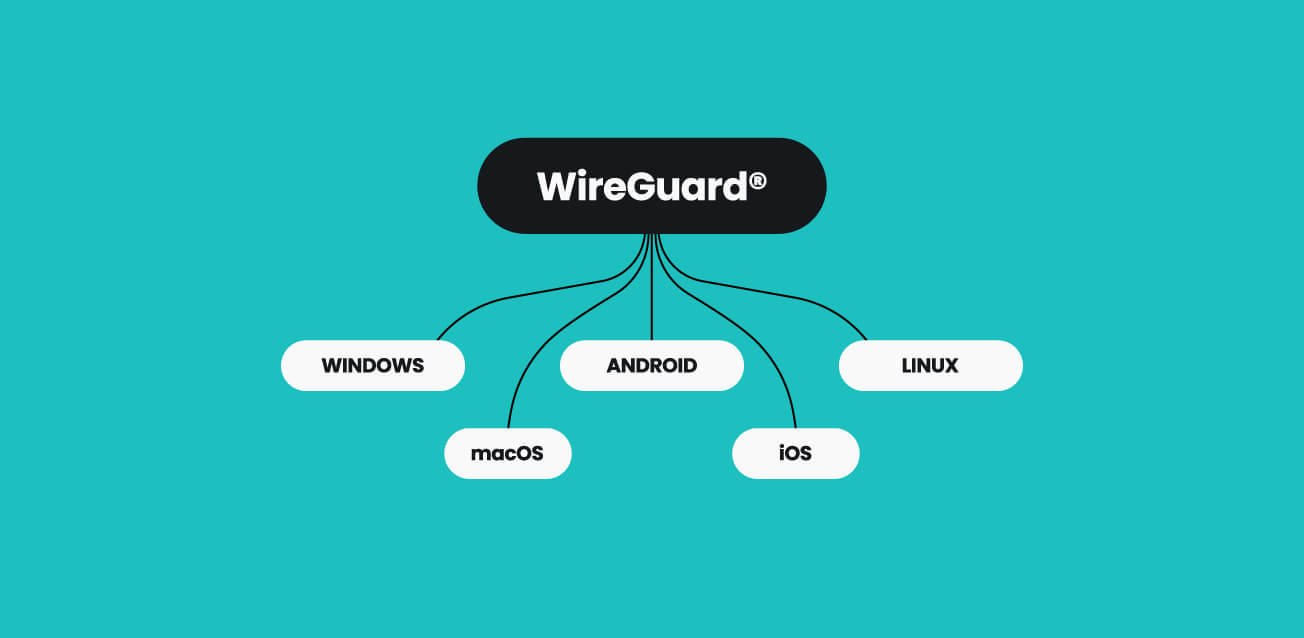
As standalone software, WireGuard offers broad platform compatibility:
- Desktop: Windows, macOS, Linux (multiple distributions);
- Mobile: iOS, Android;
- Specialized systems: FreeBSD, OpenBSD, various router firmware;
- Surfshark app support: currently available on Windows, macOS, iOS, Android, and Linux.
For more details on how to install it, visit the official WireGuard installation page.
Conclusion — get to know WireGuard at your own speed
WireGuard has established itself as the preferred VPN protocol for many users. While OpenVPN and IKEv2/IPsec still have important roles in specific scenarios, WireGuard’s modern design and outstanding performance make it the top choice for streaming, gaming, mobile use, and general browsing.
If you want to combine the benefits of WireGuard with strong privacy protections, choose a reliable VPN provider like Surfshark. A proper implementation of WireGuard ensures you get both cutting-edge performance and robust security.
Summary
WireGuard is a modern, open-source VPN protocol built for speed, security, and simplicity, using a compact codebase and state-of-the-art cryptography like Curve25519 and ChaCha20. Compared with older protocols such as OpenVPN and IKEv2/IPsec, it typically offers faster connections, lower latency, and easier configuration, making it especially well suited for streaming, gaming, mobile use, and everyday browsing. However, it currently lacks some of the advanced features, configurability, and traffic obfuscation options available with more mature protocols, and its real-world security and privacy depend heavily on how VPN providers implement and configure it. Overall, WireGuard has quickly become the preferred protocol for many users, and when combined with a trustworthy VPN service, it delivers an excellent balance of performance, security, and usability.
FAQ
Is WireGuard a VPN?
WireGuard is not a full VPN service by itself — it is a VPN protocol. It provides the technology used to create secure, encrypted tunnels between devices. While advanced users can use WireGuard to build a custom VPN setup, most people experience it as one of the protocol options inside a VPN app that uses it for fast, secure connections.
Is WireGuard free?
Yes, WireGuard is free and open-source. It was designed to be freely implemented and used by VPN providers, developers, and privacy enthusiasts.
Does WireGuard mask your IP?
WireGuard does not mask your IP address on its own, because it is only the protocol used for secure communication. To hide your IP, you need to connect to a VPN service that uses WireGuard. The VPN service then routes your traffic through its servers and assigns you a different IP address.
Can WireGuard be hacked?
Any VPN service can, in theory, be attacked, but successfully breaking WireGuard’s encryption is extremely difficult. When WireGuard is used with strong algorithms like ChaCha20 (and, in some setups, AES), the resulting encryption is practically impossible to crack with common brute-force methods using current technology.
Is WireGuard a good VPN protocol?
WireGuard is one of the safest and most secure VPN protocol options available today. Its simplified design, modern cryptography, and strong default security settings help it stand out from older, more complex protocols.
What port does WireGuard use?
WireGuard’s default port is 51820. If you want to run additional tunnels, you must use different ports. In most graphical interfaces (GUIs), the software will automatically suggest the next available port.
Does Surfshark work with WireGuard?
Yes. Surfshark has implemented WireGuard, and you can use it directly within the Surfshark app or configure it manually if you prefer.
Why is WireGuard important?
WireGuard is important because it delivers a fast, secure, and efficient VPN protocol that is simpler and easier to audit than traditional solutions. Its modern cryptographic design provides strong privacy and security while maintaining excellent performance, especially on mobile and low-power devices.
Is WireGuard a free VPN?
No. WireGuard is not a VPN service — it is a VPN protocol. Although it is open-source and free to use, it still needs to be paired with VPN server infrastructure. Developers and VPN providers can build their own services on top of WireGuard. Many commercial VPN services now offer WireGuard as a protocol option in their apps, but you need a subscription to those services to use it.